


What Is a Hanko?
A Guide to the Japanese Seal
Japanese Name Stamps, Inkan & Custom Seals
| KAMAKURA HANKO
Hanko, inkan, japanese name stamps explained. Learn the difference between Jitsuin, Ginkoin, Mitomein and Yuin, and order a custom hand-carved hanko in Kanji, Katakana, or your own design.
Hanko, Inkan, Seal — What’s the Difference?
In English, hanko, inkan, and seal are often used as if they meant the same thing. In Japan, they do not.
Hanko (判子)
The everyday Japanese word for the physical object — the carved cylinder of wood, horn, or stone that you hold in your hand. When Japanese people say “my hanko”, they mean the piece itself.
Inkan (印鑑)
The impression the hanko leaves on paper — and, in formal contexts, the registered seal filed with a city office for legal use. A hanko becomes an inkan when it is recognized as your official mark.
Seal
The English umbrella term. It covers both the object and the impression, but it carries none of the cultural weight that hanko and inkan carry in Japan.
Hanko is what you hold. Inkan is what you leave behind.
A Kamakura Hanko by KAMAKURA SIGNET is, in the strictest sense, both — a hand-carved hanko, and the inkan that will stand for you across a lifetime.
Hanko vs Signature — Why Japan Presses Instead of Signs
In most of the world, your name is written. In Japan, your name is pressed.
A signature is a gesture — fluid, repeatable, and never identical twice.
A hanko is an object — carved once, and capable of leaving the exact same mark for a lifetime.
In Japan, a hanko carries the same legal weight as a signature, and in some moments, more.
It is used for:
-
Marriage and family registers
-
Founding a company
-
Buying a home
-
Inheritance and wills
-
Banking and contracts of importance
For the Japanese, a hanko is not a stamp.
It is the printed version of who you are — composed with care, carved by hand, and trusted to speak for you long after the moment of signing is over.
A signature ends with the page.
A hanko continues with the person.
Below is an introduction to the cultural role of Hanko in Japan:
Japanese Hanko: A Cultural Tradition and Daily Essential
In Japan, seals — known as "hanko" — are indispensable tools for verifying identity and authenticity. Deeply ingrained in Japanese culture and business practices, they serve a variety of purposes, from official documents to everyday transactions.
JITSUIN — Official seal registered with the city office. Used for the most important legal contracts.
GINKOIN — Registered with the bank. Used for banking transactions.
MITOMEIN — Daily personal seal. Used for deliveries and everyday documents.
YUIN — Decorative seal. Used for letters, books, and art.
Can Foreigners Have a Japanese Hanko?
yes — anyone can own a hanko, and many already do.
A hanko is not reserved for Japanese citizens.
Foreign residents, international clients, and visitors to Kamakura regularly commission a hanko of their own — sometimes for practical reasons, often for the beauty of the object itself.
For residents of Japan
If you live in Japan, your hanko can be registered with your local city office and used as your inkan tōroku (印鑑登録) — your legally recognized personal seal — for contracts, real estate, banking, and family registration. Foreign residents may register a hanko in their legal name, in Katakana, in Kanji, or in an approved combination, depending on the city.
For visitors to Japan
If you are traveling in Japan, your hanko need not be legal — it can be personal.
A hand-carved Kamakura hanko becomes a private object: used to seal letters and gifts, to mark personal books and art, or simply kept as a piece of Japanese craft tied to your own name. Many of our international clients commission a hanko during a single visit to Kamakura, and use it for the rest of their lives.
For clients abroad
For clients outside Japan, a KAMAKURA SIGNET hanko is created in our atelier and delivered worldwide, ready to be used or displayed as a personal heirloom.
There is no border to a name.
A hanko simply gives it a permanent form.
Kanji, Katakana, or Your Own Design — Three Equal Ways to Make Your Hanko
There is more than one way to write your name in Japanese — and at KAMAKURA SIGNET, we treat each one with equal respect.
Every commission begins with a choice between three paths.
Whichever you select, the carving is the same: hand-engraved in Kamakura, by a nationally certified master.
① Kanji — Your Name in Meaning
Kanji are characters that carry meaning as well as sound.
For foreign names, our master selects characters that match the pronunciation of your name while reflecting qualities you wish to carry — clarity, strength, grace, faith, harmony.
A Kanji hanko is a name with intention.
It is read as your name, and admired for what it suggests beyond it.
Example: “Maria” may be composed as 真理愛 — “truth, reason, love.”
② Katakana — Your Name in Sound
Katakana is the Japanese script designed to render the sound of foreign words and names.
Its lines are sharp, balanced, and architectural — a script that, on a hanko, reads with quiet modern elegance.
A Katakana hanko keeps your name exactly as it sounds in your own language, presented in a uniquely Japanese form.
Example: “Maria” becomes マリア — sound, precisely shaped.
We recommend Kanji and Katakana equally.
The choice is not one of correctness, but of personal voice: meaning, or sound.
③ Your Own Design — Brought from Your Hand
If you already have a design, a sketch, a family crest, a logo, or a personal signature you wish to carry into your hanko, we accept your data and craft an original, one-of-a-kind seal built around it.
Our master will refine your design for the discipline of carving — adjusting weight, balance, and depth — while preserving its character.
What you receive is an object that is yours alone, in form as well as in name.
How a Kamakura Hanko Is Made for You
-
Order online — choose Kanji, Katakana, or Your Own Design.
-
The master proposes a design — calligraphy, balance, and meaning are arranged for your name.
-
You confirm — review the proposal and request any adjustments.
-
Hand-engraved in Kamakura — carved by a 1st Grade nationally certified master, then sent to you worldwide.
The Master Collection


VISIT THE KAMAKURA ATELIER
Kamakura gives KAMAKURA SIGNET its atmosphere: quiet, historical, disciplined, and deeply tactile. Here, each work is designed, carved, and finished in an environment where craft is not a trend, but a way of life. The result is a signet that carries the spirit of place as much as the name it bears.
Using Your Hanko — The Perfect HANKO
If you already have a hanko, are you sure you know how to use it correctly? Everyone who has used a Hanko will have encountered some or all of the following issues: stamping your name upside down or at an angle, smudging the HANKO, getting an uneven print, or even double stamping. Despite its simplicity, using a hanko is an art and takes practice.
Here are some quick tips to help ease the process:

1. Buying Your Hanko
Although cheap Hanko are readily available at numerous stores around Japan, the quality and materials used are more important than you might think. High-quality Hanko reduce the risk of ink bleeding outside the carved lines and are built to last. This means that you will not need to replace them frequently. By opting for a custom, personalized HANKO, you can specify both the materials and the design, ensuring it meets your aesthetic preferences and durability requirements.

3. Tap that Red Ink
One of the easiest mistakes to make is to press the hanko into the red ink pad too hard, causing the ink to bleed between the lettering. Instead, lightly tap your hanko into the ink pad 2-3 times, creating more even ink distribution. While it's true that many modern ink pads use fast drying ink that minimizes the risk of blotting, it never hurts to have a light touch.
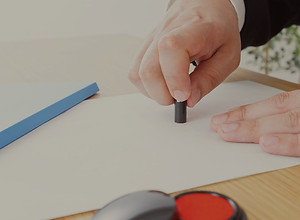
5. Make a Shape When You HANKO
To ensure an evenly distributed HANKO — without missing letters that will require you to repeat the action — imagine you’re writing the hiragana character while pressing down. If you’re not too confident about your hiragana skills, adding pressure in a clockwise motion will provide a similar effect.

2.Holding Your Hanko
Holding your Hanko correctly can significantly reduce the chances of accidental blurring or stamping your name upside down. Grip the Hanko between your finger (positioned at 12 o'clock) and your thumb (positioned at 7 o'clock if right handed, and 5 o'clock if left handed), and bend your middle finger to provide support on the opposite side. Always check the bottom of the HANKO to ensure the top of your name is aligned with your forefinger. The top end of the Hanko should press against the ball of your hand for added balance. Maintain a firm grip and lower the Hanko slowly to achieve an even, perpendicular imprint.

4. Make Your Mark Using a Mat
A natsuin mat — a HANKO mat — is a cushioned mat used underneath the paper you’re stamping, and is a worthwhile investment for business use. The mat helps even out the pressure to create a smooth imprint and is a necessity when stamping on uneven desk surfaces. It also has the extra advantage of preventing slippage.

6. Clean the Hanko When You’re Done
It goes without saying that cleaning your hanko after use is a good idea. You’ll avoid getting ink everywhere and it will also make your hanko stay in better shape for longer. Simply wipe with a tissue or soft cloth before returning it to your hanko case.
TAKING CARE OF YOUR HANKO
It’s important to treat your Hanko with care. Consider your registered Hanko as important as your passport and store it safely, ideally under lock and key.
Here's some basic advice for Hanko care:
01.
Keep your Hanko in its case when not in use to prevent any external damage.
02.
Keep it in a cool and dry place, away from direct sunlight.
03.
After use, make sure to wipe off any residual ink.
04.
Store your jitsuin Hanko separately from the Hanko registration card or any contracts you have used it with.
05.
Store your ginkoin hanko in a different place from your bank book.
Signed and Sealed
The Hanko’s role in Japan still holds utmost importance as contracts signed and stamped with a Hanko provide the greatest levels of proof. For example, documents affirmed with both a handwritten signature in addition to a Hanko hold the highest credence in the court of law (followed by handwritten signature alone, digital signature plus hanko, and digital signature alone). As such, use your Hanko wisely when applying your HANKO to legal documents such as debt repayments, joint guarantor contracts, etc. Always check the content of a contract carefully and make sure you agree to all the terms before legitimizing with your Hanko. While the Hanko makes for a great souvenir, it also plays an indelible role in everyday Japanese society.